¶ The Caravaneers
The road remembers every deal.
¶ Contents
- What Your Character Knows
- The Guiding Principle
- Kinships of the Road
- Marks of Passage
- Among the Five Factions
- Faith Beyond the City
- What the Caravaneers Mean to You
¶ What Your Character Knows
The Caravaneers connect Athkatla to the world beyond its walls. Their wagons, ships, guides and waystations carry goods and travellers throughout Amn and far beyond it. The Guilds may produce Athkatla’s wealth, but without the Caravaneers that wealth would never reach a market.
Despite their name, the Caravaneers are not a single company. They are a far-reaching association of travelling families, independent companies, scouts, guards, drovers, navigators and innkeepers. Some cross the continent; others spend their entire lives maintaining a single bridge, oasis or mountain pass. All participate in the same network of routes, hospitality and obligation.
The Caravaneers regulate overland trade entering and leaving Athkatla. They maintain records of shipments, certify guides, negotiate safe passage and share warnings about dangerous roads. Their authority becomes weaker the farther one travels from the city—but their relationships become more important.
Their agreements are upheld less by written law than by reputation. A contract may be witnessed beside a fire and sealed with nothing more than shared salt, yet breaking it can close every stable, waystation and caravan in Amn against you.
To outsiders, the Caravaneers represent freedom and the romance of the open road. Those raised among them know better:
The road offers freedom, but never freedom from obligation.
¶ The Guiding Principle
The Caravaneers care little whether one travels by road, river, open sky or across unmarked sand. What binds them is the Guiding Principle: five ancient obligations governing life beyond the safety of the City.
There is no single authoritative name or wording. Every travelling culture has translated the Principle into its own language and landscape. To some it is the stone beneath their feet; to others the current between shores, the wind before them or the flame they carry through darkness. All are understood as expressions of the same promise.
¶ The Five Truths
When there is Desert, the Desert is the only enemy.
In storm, drought, darkness or other mortal danger, all travellers are owed shelter. Feuds, prices and allegiances must wait until the danger has passed. The “Desert” means any wilderness powerful enough to kill without caring who was right.
When the Desert is tame, respect another’s chosen foe.
Every traveller may carry a hunt, rivalry or vengeance of their own. Do not steal another’s quarry, interfere without invitation or use the Guiding Principle to escape a reckoning freely chosen. Aid may be offered, but another’s foe is not yours to claim.
Counsel is precious; it need not always see the sun.
Do not burden others with guidance they neither requested nor require. A traveller is entitled to choose their own path and make their own mistakes. Speak freely only when you know of a danger they could not reasonably foresee—and never offer rumour as warning.
Beyond the City, only need is honest currency.
Food, water, shelter and aid must be answered in kind when circumstances allow. Coin cannot quench thirst, bind a wound or pull a wagon from the sand. To waste water or deny it for profit is considered particularly shameful.
No blade crosses bread.
No violence may begin at a shared table, beneath a host’s roof, inside a traveller’s tent or around a common fire. Those who intend to resume killing one another must first finish the meal, leave the shelter and walk beyond sight of their host.
Many paths. One horizon. Five truths between us.
¶ Names Across the Roads
The Guiding Principle has no original or authoritative name. Travelling peoples have translated and reimagined it through their own languages and landscapes.
The names below draw openly upon real-world languages as inspiration. They represent Athkatlan expressions rather than the beliefs or traditions of their real-world speakers.
| Athkatlan language | Name of the Principle | Meaning in Common | Real-world inspiration |
|---|---|---|---|
| Common | The Guiding Principle | The shared obligations of travellers | — |
| Terran | A Lábunk Alatti Kő | The Stone Beneath Our Feet | Hungarian |
| Auran | Avannaq | The North Wind | Kalaallisut, the Greenlandic language |
| Aquan | Te Ia i Waenganui | The Current Between | te reo Māori |
| Ignan | Ny Lelafo Entintsika | The Flame We Carry | Malagasy |
| T’Aan Tabaxan | Ohtli | The Path | Nahuatl, reflecting T’Aan’s Maztican origins |
Different names. The same promise.
¶ Kinships of the Road
The Caravaneers organise themselves into kinships formed through blood, marriage, adoption, apprenticeship or journeys survived together. Some span Amn; others consist of a single wagon and those who call it home.
Each expedition chooses a caravan-master whose authority lasts only for that journey. Leadership follows experience: a merchant may negotiate the contract, a scout choose the route and a drover command when the animals panic.
Disputes are settled at moots along the major routes. Respected veterans form the Desert Assembly which coordinates shared interests and chooses a retired Caravaneer to represent them upon the Council of Five.
Only those who have left the horizon may speak for all who follow it.
¶ Marks of Passage
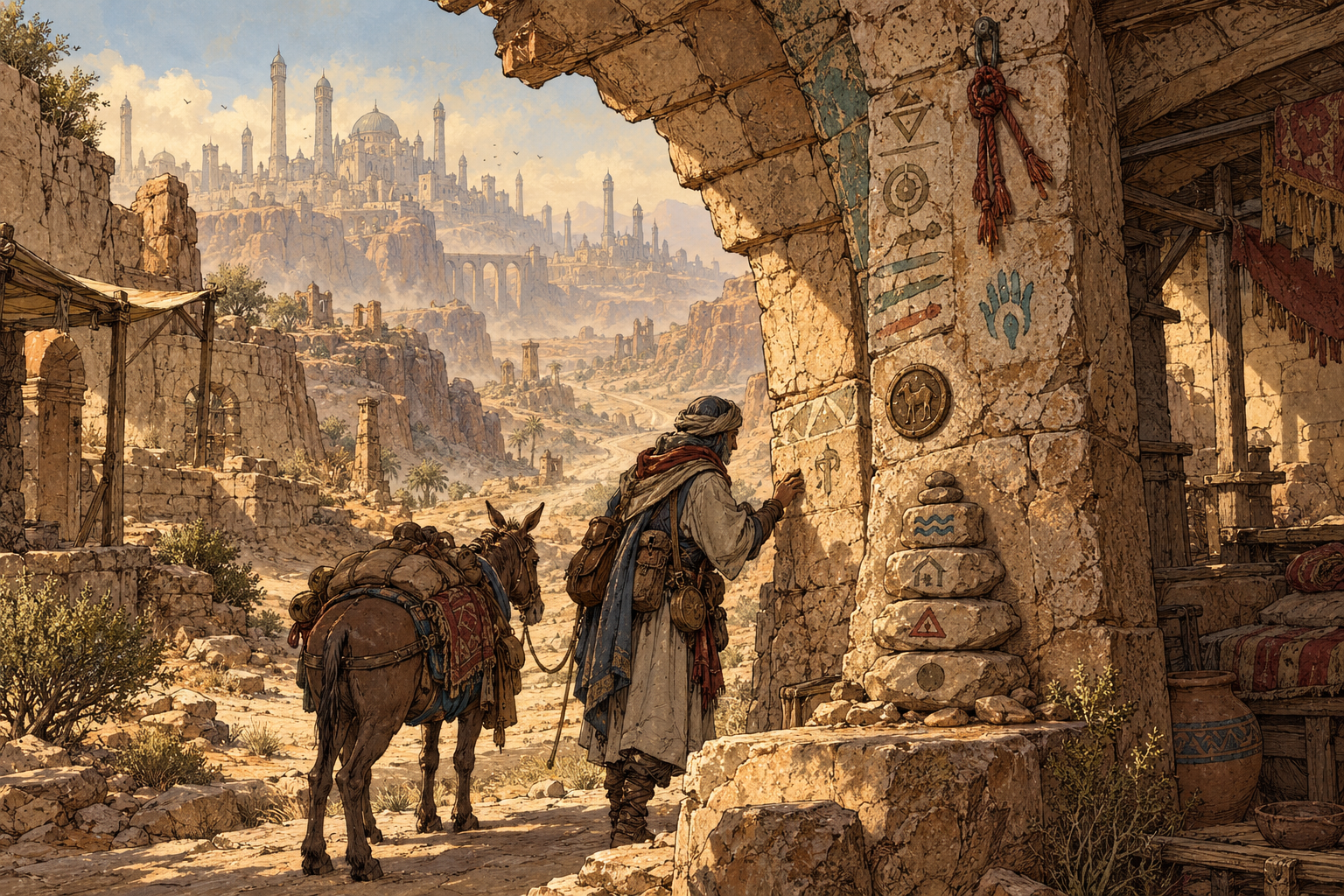
Caravaneers recognise one another through marks of passage: knotted cords, stamped tokens, painted signs and phrases whose meaning changes from route to route. These identify trusted guides, safe camps, water sources and obligations still owed.
No single person understands every mark. Knowledge belongs to those who have travelled a route or earned the trust of those who do. Copying a mark without permission is considered both theft and a dangerous lie.
A Caravaneer arriving among strangers may know neither their names nor their language, yet still recognise where water is shared, which shelter is safe and whose word can be trusted.
A road need not be written to be read.
¶ Among the Five Factions
The Caravaneers rarely seek control within Athkatla, but their cooperation is essential to every faction that does. Their allies respect them, depend upon them and occasionally attempt to restrain them.
-
The Guilds hold the Caravaneers in the highest regard. One makes what the other moves, and they frequently stand together against the other three Factions of Coin. Yet the Guilds sometimes resist Caravaneer autonomy, especially when passage costs rise or valuable cargo arrives damaged. Their arguments are frequent, loud and usually temporary; neither can afford a lasting break.
-
The Temple of Waukeen also speaks highly of the Caravaneers, though many regard this respect as hollow. The Temple can transport its wealth aboard grand ships without their assistance—until those gilded vessels require a pilot, guide or safe harbour. Its more devout priests sincerely bless Caravaneers and understand the sanctity of their work, but such believers rarely occupy the Temple’s highest offices nowadays. The Temple entrusts them with tithes, pilgrims and sacred commerce while struggling with customs that place water and shelter beyond the reach of coin.
-
The Arcanists exchange knowledge and magic with the Caravaneers in both directions. Spells may reveal a route, but experienced guides know how that route changes with season, weather and danger. Most Arcanists happily avoid the strain and expense of transporting people and cargo by teleportation when the Caravaneers can accomplish the same task more reliably.
-
The Shifting Sands are information brokers. They understand that smugglers and shadow markets already flourish among the Caravaneers, leaving the Sands little to contribute through contraband alone. Instead, they trade in manifests, debts, rivalries and compromised agreements. Through blackmail, forged contracts and carefully brokered disputes, they quietly chip away at Caravaneer autonomy. Whenever a kinship falls or a route loses its master, the Sands move quickly into the opening.
The other factions often intervene when the Sands threaten the Caravaneers—but only while their own relations with the road remain favourable. The Caravaneers therefore know that dependence inspires loyalty only until it becomes inconvenient.
All Athkatla honours the hand upon the wheel—until it chooses another direction.
¶ Faith Beyond the City
Most Caravaneers keep their distance from the great temples of Athkatla. Waukeen’s priests may bless commerce, but the road teaches that coin holds little power over thirst, weather or wilderness. Among the Caravaneers, devotion to Waukeen is uncommon and sometimes viewed as a faith meant for those who expect the world to honour a contract.
The strong presence of genasi, aarakocra, tabaxi and other widely travelled peoples has given the Caravaneers a more varied spiritual life. Their traditions retain connections to the Elemental Planes, the Feywild and distant lands where deities forgotten in Amn remain sacred.
Their faith is usually local, practical and animistic. A spring may have a keeper, a storm a temper and an ancient tree a memory. Travellers leave offerings at dangerous crossings, ask permission before taking from certain places and learn which spirits should be thanked, placated or avoided.
Druids, spirit-speakers and wandering priests are more common among them than temple clergy. Different beliefs mix freely: a caravan might honour an elemental ancestor at dawn, leave bread for a roadside spirit at noon and sing to a foreign god beneath the evening stars.
The Caravaneers rarely insist that one tradition must be true everywhere. A deity powerful in Athkatla may hold no authority in the deep desert, while an unnamed spirit may rule a single well completely.
Every land has powers of its own. A wise traveller learns their names.
¶ What the Caravaneers Mean to You
The Caravaneers have given you more than work. Through them, you can find shelter among strangers, recognise warnings left by travellers long departed and call upon kinships whose names carry weight across Amn.
That belonging carries obligations. Your word reflects upon those who travel beside you. Cargo Cargo accepted under your protection must be delivered or accounted for. Aid received beyond the City must one day be returned—even if not to the person who first gave it.
You are not expected to obey every Caravaneer, defend every kinship or surrender your own rivalries. You are expected to honour the Guiding Principle when the Desert rises.
Cities may offer safety, wealth and permanence. The Caravaneers offer something else:
Wherever the horizon opens, you are not without kin.